
BD268XZ Explained Meaning, Uses, Benefits, and Future in Digital Systems


You’ve probably seen a odd code like BD268XZ and wondered what it does. Maybe it showed up in a log file. Maybe a vendor dropped it into a proposal. This BD268XZ guide helps you sort the facts from the guesses. You’ll get a clear BD268XZ meaning, a look at BD268XZ uses, and honest advice on the BD268XZ implementation.
Here’s the key point up front. No public source confirms what BD268XZ is. So this BD268XZ explained article treats it as an alphanumeric unique identification code and shows how codes like it work. Think of it as a technical code explanation you can trust. You’ll see where it could fit in digital systems, where it could go wrong, and how to check any claim before you act on it.
What Is BD268XZ? Understanding Its Meaning and Purpose
So, what is BD268XZ? It’s a string of letters and numbers. That’s all we can confirm. Without a creator’s note or a technical specification, the BD268XZ definition stays open. It could be an internal reference code or a product label. It could also be a database key or a tracking tag. Each of these is a guess, not a fact. The purpose of BD268XZ depends on who made it and where it lives.
Context is your best clue. Look at the software that displays the code. Check the documents around it. Then search official product pages, code repositories, and trusted industry sites. If nothing turns up, treat the BD268XZ code as a plain digital code identification value. Don’t call it a product or a standard. A careful reader keeps the BD268XZ meaning open until proof arrives.
Why Is BD268XZ Important in Modern Technology?
Picture a huge warehouse with no labels on any box. Finding one item would take forever. Digital identification systems fix this problem. Each record gets a tag, and software finds it fast. If BD268XZ plays this role, its value comes from the rules around it. The characters alone do nothing. This is the purpose of BD268XZ in its simplest form.
Good tags also keep teams in sync. Sales, billing, and shipping tools can all point to the same record. That’s strong identifier management at work. It’s also a sign of broader digital technology trends, where connected tools share one source of truth. Here are three reasons identifiers matter so much.
Handling Large-Scale Data Efficiently
Big databases hold millions of rows. A stable unique identifier code lets software jump straight to one row instead of scanning them all. Good database indexing methods speed this up even more. Still, an identifier isn’t magic. Hardware, network speed, and workload shape BD268XZ performance too. For true data processing efficiency, test the whole system. Don’t trust the code alone.
Supporting Data Integrity and System Security
Unique tags stop records from overwriting each other. That’s basic data integrity protection. The database can reject a second record with the same tag. However, a code is not a password. Anyone can copy it from a screen. Real system security practices need logins, permissions, and encryption. Treat BD268XZ as a label only. Never treat it as a key to a locked door.
Improving Communication Between Distributed Systems
Think of an online order number. The store, the payment tool, and the courier all use it. That’s distributed system communication in action. Each tool must read the code the same way. If one tool expects ten characters and another sends eight, errors follow. Agree on a format early. Then each part of your digital infrastructure speaks the same language.
How Does BD268XZ Work in Digital Systems?
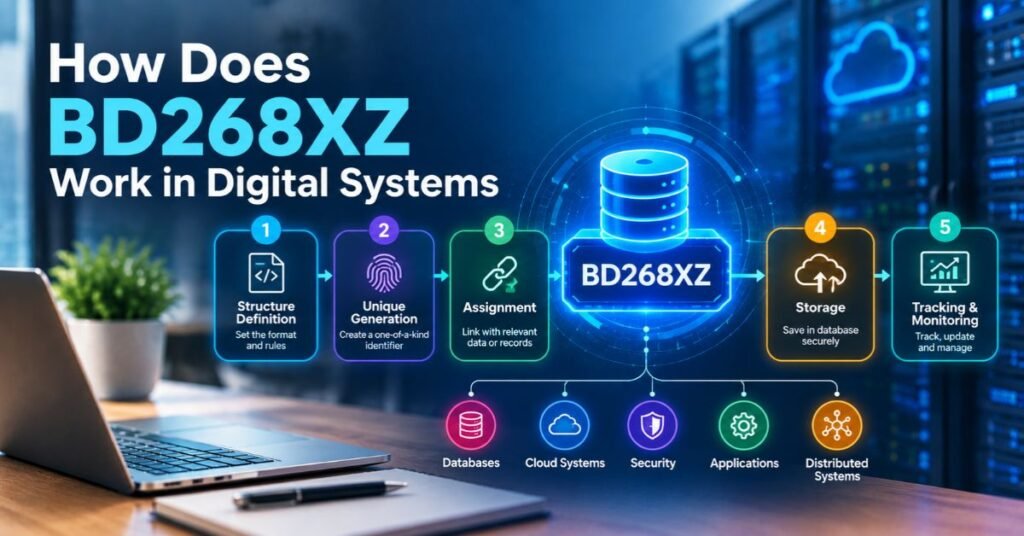
Think of a library card. The number on it isn’t the books. It just points to your account. How BD268XZ works would follow the same idea if it acts as an identifier. A system assigns the code, links it to data, and looks it up later. This is the core of BD268XZ functionality in any data management system.
One warning matters here. The five steps below are a general model. They are not a confirmed BD268XZ technical details sheet. Real systems differ. Use the steps as a map for your own BD268XZ implementation process, and adjust them to match your tools and your rules.
| Step | What Happens | Main Goal |
| 1 | Define the format | Clear rules |
| 2 | Generate the code | Uniqueness |
| 3 | Link to data | Fast lookup |
| 4 | Store records | Safety and order |
| 5 | Track changes | Accountability |
Step 1: Defining the BD268XZ Structure
Start with the BD268XZ structure. Decide which characters are allowed. Pick a fixed length. Set the capital letter rule. You might add a prefix to mark a category. Write every rule down before launch. Clear rules make checks easy. They also cut errors during imports and API calls. A well-defined format is the base of a strong BD268XZ implementation.
Step 2: Generating or Assigning an Identifier
Next, create the code. An app can generate it. A database can generate it. An admin can assign it by hand. Whatever you choose, avoid collisions. A collision happens when two records get the same code. This is where identifier generation needs care. A short code like BD268XZ isn’t unique unless the issuing system promises it. For shared systems, read about modern UUID standards in RFC 9562.
Step 3: Linking BD268XZ to Relevant Data
A code only helps if it points somewhere. Your system ties it to a name, a date, a status, or a file. That’s the heart of database record management. The code doesn’t need to hold the data. It just needs to find it. Names change and addresses move. A steady code stays put. This is why BD268XZ database integration often starts with a simple lookup table.
Step 4: Storing and Managing Records
Now store everything safely. Relational databases such as PostgreSQL and MySQL can enforce unique values. See the PostgreSQL constraints guide for details. Good data storage management also means backups, access rules, and retention plans. Pick a design that fits your data size and your query habits. This choice shapes BD268XZ data management for years.
Step 5: Tracking and Monitoring Information
Last comes tracking. Systems can log when a record is made, edited, or archived. That’s the BD268XZ tracking process in action. It supports digital record tracking and clean audit trails. But note this well. A code doesn’t track anything alone. You need logging tools and clear policies. Add system performance monitoring so problems show up early.
Key Applications of BD268XZ in Digital Systems
Let’s be honest first. We can’t confirm any real BD268XZ applications. What we can do is look at how similar codes get used. These are BD268XZ practical applications by comparison, not proven facts. Use them as a thinking tool when you judge a code like this one.
Fit depends on four things. These are uniqueness, readability, security, and compatibility. The table below shows common uses and the key need for each. Check your own needs against it. That way your BD268XZ uses match real goals instead of hype.
| Use Case | Role of the Identifier | Key Requirement |
| Databases | Row reference | Uniqueness |
| APIs | Resource pointer | Validation |
| Security tools | Event or account label | Access control |
| Cloud platforms | Resource tracking | Clear scope |
| AI workflows | Input and output link | Documentation |
BD268XZ in Database Management
Databases lean on keys. A code like this could serve as a reference key if it meets your needs. Choose a data type and set constraints first. Decide if the code must stay fixed when other fields change. Strong database identification keeps tables linked and reports clean. It also supports better data organization across a growing data management system.
BD268XZ in APIs and Backend Systems
APIs pass requests between apps. An identifier often sits in a URL or a message body. Good API integration methods validate every incoming value. They also avoid easy-to-guess codes. Predictable codes let strangers guess their way to other records. So pair each backend system identifier with strict permission checks. That’s smart backend system integration.
BD268XZ in Cybersecurity and Access Management
Security tools tag accounts, devices, sessions, and alerts. A code can help an analyst follow a trail. Yet identification and authentication are not the same thing. Knowing a code shouldn’t unlock anything. Solid access control mechanisms use verified logins and least-privilege rules. Those are the real cybersecurity measures. The code is just a label on the file.
BD268XZ in Cloud Computing Platforms
Cloud tools track servers, storage, and jobs with identifiers. A shared tag links logs across many machines. That’s a core feature of cloud computing infrastructure and cloud-based data systems. Set the scope early. Decide whether the code works in testing and live systems alike. Add retention rules too. Clear planning keeps your modern computing systems tidy.
BD268XZ in Artificial Intelligence and Automation
AI tools pull data from many sources. Identifiers connect each input to its output and its log. Automation tools also use them to trigger tasks. Still, this code has no proven link to any AI model. Any such claim needs documents. For workflow automation and artificial intelligence systems, define the role in writing. Otherwise you’re guessing.
What Are the Main Benefits of BD268XZ?

A good label saves hours. That’s the simple promise of a well-built identifier. The BD268XZ benefits below only appear with strong design. They aren’t built into the characters. Keep that in mind as you read. The gains come from care, testing, and clear rules.
You’ll notice the biggest wins when many apps share the same records. Reports match. Searches finish faster. Teams stop arguing over which file is right. That’s why digital transformation projects often begin with identifier clean-up. They make business technology solutions easier to join together.
Read More: TheJavaSea me Leaks AIO TLP371 Risks, Facts, and Online Safety Guide 2026
Improved Data Organization and Management
A stable code gives each record a home. Tables, modules, and reports can all point to it. Teams find items without relying on names that change. Clear naming rules also reduce mix-ups between similar items. This is data organization at its best. It needs good design and checks, though. The code format alone won’t do it.
Scalability for Growing Digital Systems
Growth tests every design. A scalable plan picks a smart generation method and sets the uniqueness scope. It also expects future tools to join in. Before you commit, test BD268XZ under real loads. That’s how you build scalable digital systems that don’t crack under pressure. Plan for ten times your current volume. You’ll sleep better.
Better Data Tracking and Traceability
Add timestamps and status fields. Then add audit logs. Now you can follow a record from birth to archive. Picture a service team linking a customer request to its shipping file with one code. That’s data traceability in practice. It depends on solid logs and retention. The code alone gives you only half the trail.
Potential Performance and Efficiency Improvements
With the right index, a database can find one record without scanning every row. That can speed up lookups. See the PostgreSQL index guide for the basics. However, results depend on data type, storage engine, and query mix. Benchmark the full system before you claim savings. Honest numbers beat bold promises.
What Are the Challenges of Implementing BD268XZ?
It looks simple on paper. In practice, it’s trickier. Every new code touches APIs, reports, and old tools. These technology implementation challenges show up in most projects. Plan for them early. Doing so keeps the BD268XZ implementation smooth and the budget safe.
Before you start, confirm what the code truly represents. Then run a small pilot. A pilot reveals trouble while the stakes are low. It also builds trust with your team. Many software implementation challenges come from skipping this step. Don’t be the team that learns the hard way.
Technical Complexity and Setup Requirements
Even a short code needs rules. Developers must write generation logic, checks, and error messages. Someone must own the namespace. Docs need updates too. These BD268XZ system requirements add up fast. A pilot run helps you see the real workload. It’s cheaper to fix a plan than a live system. Think of it as a dress rehearsal.
Data Storage and Indexing Considerations
Pick a storage type that matches the format. A fixed-length string often suits a stable code. Indexes speed up reads. But they take space and slow writes. So test real queries before you decide. Smart database indexing balances speed, cost, and upkeep. Review it again as the data grows. What works at ten thousand rows may struggle at ten million.
Compatibility With Existing Systems
Older tools may expect number-only keys. Some limit field length. Others reject certain characters. Check schemas, API contracts, and import tools before launch. BD268XZ compatibility problems often hide in third-party links. A mapping layer can help during the switch. It keeps old and new tools talking. That’s practical system compatibility work, and it saves late-night fixes.
Duplicate Identifiers and Data Integrity Risks
Duplicates are a quiet danger. Two records share one code. Then data blends or goes missing. The risk grows when many systems create codes alone. Use database constraints and collision checks. Good identifier duplication prevention also needs a clear plan for fixing errors. Decide who finds duplicates and who repairs them. Strong duplicate identifier prevention protects your data integrity.
Case study (illustrative example): A small online shop let two tools create order codes. Both tools used five-digit numbers. Within a month, two customers shared one code. A refund went to the wrong person. The fix was simple. The shop moved code creation into one database with a unique rule. Errors stopped.
Best Practices for Using BD268XZ Effectively
Want a quick checklist? Here it is. These habits work for any alphanumeric code. They apply to product tags, order numbers, and device labels alike. Follow them and your digital identifier management gets stronger. Skip them and small slips grow into costly messes.
Write your decisions down early. Review them as needs change. The table below sums up each habit, why it matters, and a quick tip. Read it once. Then read the details that follow. You’ll spot gaps in your own setup quickly.
| Practice | Why It Matters | Quick Tip |
| Consistent format | Fewer errors | Enforce rules everywhere |
| Smart indexing | Faster lookups | Follow query patterns |
| No duplicates | Clean data | Use database constraints |
| Security controls | Safer records | Check every request |
| Regular monitoring | Early warnings | Set alerts |
Maintain a Consistent Format
Set the allowed characters, the length, and the capital letter rule. Then make every app follow them. If you must change the format later, plan a migration first. Consistency stops errors during imports, API requests, and lookups. It also keeps your BD268XZ structure easy to explain. Small rules now prevent big headaches later.
Use Appropriate Database Indexing
Don’t index every field. Index what you search often. If the code finds single records, a unique index may fit well. Review query plans and watch index speed. The right answer depends on your engine and your insert rate. Smart database indexing methods save time and storage. They keep BD268XZ database integration quick and light.
Prevent Duplicate Records
Use a reliable generation process. Back it with a database-level unique rule. App checks give early warnings. Database rules give the final safety net. For many servers, pick a method built for shared use. Then test collision handling before launch. That’s the best way to protect data integrity protection over time.
Apply Suitable Security Controls
Treat codes as references. They are not secrets. Require logins and check permissions on every request. Keep personal or private details out of the code itself. Also think about where codes appear. Logs and URLs can leak clues. Review the OWASP Top 10 for common access flaws. Solid BD268XZ security considerations start here.
Read More: 20xBusiness com Review 2026 Ultimate Guide to Features & Trust
Monitor System Performance Regularly
Watch lookup times, failed calls, and duplicate-key errors. Check them after each release. Check them again when data grows. Set alerts so you hear about trouble first. Regular checks help you tell code problems from network or database issues. That’s practical BD268XZ performance care. It keeps your technical system reliability high.
Is BD268XZ Secure and Reliable?
A complex-looking code isn’t automatically safe. Looks tell you nothing about how it was made or stored. Security comes from the system around it. That system creates, stores, sends, and checks the code. Judge BD268XZ reliability by that system, not by the string.
So review the setup before you trust it. Ask who built it. Ask how it handles errors. Ask how it protects data. A careful review supports digital system reliability and shields your users. It also shows whether a claim about BD268XZ holds up under pressure.
Understanding Data Protection and Access Controls
Strong systems mix good identifier habits with real protection. Role-based access limits who sees what. Encryption guards data in storage and in transit. Secure backups and audit logs add more safety. If personal data is involved, follow privacy laws and your own policies. These access control mechanisms form the core of data integrity protection.
Common Security Risks to Consider
Watch for predictable codes and open record access. Watch for leaky logs and weak input checks. Even random-looking codes fail if the app skips permission checks. Another risk is linking a code to the wrong record. Review how codes are made, where they appear, and what a stranger could pull up with one. These are the BD268XZ security considerations that matter most.
How to Evaluate Implementation Reliability
Start by finding who defines BD268XZ. Read their documents, version history, and security notes. For an internal setup, review the source code, database rules, and test results. Consider outside security testing for critical systems. If no trusted source explains the code, don’t call it a standard. A clear check like this protects your technology infrastructure development plans.
What Is the Future of BD268XZ in Technology?
Crystal balls aren’t included here. No proof exists to predict BD268XZ adoption. It may stay an internal label. It may grow into something bigger. We simply can’t say. So the sections below discuss BD268XZ future applications only as possibilities.
Still, one trend is clear. Reliable identifiers will stay important. Cloud tools, automation, and connected devices all need them. That fits wider emerging digital technologies and digital technology trends. Any code that meets these needs could find a role. Whether BD268XZ does is a matter of evidence.
Potential Role in Cloud Computing
Cloud platforms track resources, jobs, events, and stored files. A code like this could serve as an internal reference if its life cycle fits. Future designs will keep needing clear identity, clean logs, and shared interfaces. Those are the building blocks of cloud computing infrastructure. These general trends don’t prove a specific role for BD268XZ, though.
Possible Applications in AI and Automation
Automated tools must link inputs, outputs, and actions to the right records. Identifiers support workflow tracking and data labeling. They also help teams trace errors. If BD268XZ joins an AI project, spell out its job in the docs. Any claim that it boosts a model needs measured proof. Without it, the claim is just talk.
Potential Integration With Blockchain Systems
Blockchains use transaction IDs, block references, and wallet addresses. A plain code could act as an outside reference in such a system. But a code alone doesn’t give you tamper-proof records or decentralized checks. Those traits come from the protocol itself. So any blockchain integration needs a proper design. The label is only a small piece of it.
Emerging Uses in the Internet of Things (IoT)
Sensors, machines, and smart devices need unique tags. A tag links readings, repairs, and alerts to the right device. A code like BD268XZ might fit one such scheme if it stays unique and trackable over time. That’s the promise of Internet of Things technology. Right now, though, this use remains a hypothesis. No evidence backs it yet.
Why Should Businesses Understand BD268XZ?
Imagine a vendor sends a proposal with BD268XZ in it. Do you sign? Not yet. Unfamiliar terms deserve a closer look before you spend money or change your tools. The code may be an internal label or an unproven buzzword. Checking first protects your budget and your reputation.
Focus on needs instead. Good identification should give reliable lookups, steady formats, and controlled access. It should also fit your current software. Ask vendors for proof of function, limits, and system integration details. Consider upkeep costs and data retention too. These steps turn confusion into smart digital transformation choices.
Common Misconceptions About BD268XZ
Strange codes invite big assumptions. People guess at power they can’t prove. That’s human nature. But sound decisions need evidence. So treat BD268XZ like any other technical term. Ask where it came from and who stands behind it.
Three myths come up often. Let’s look at each one. You’ll see that most of them mix real ideas with unproven claims. Separate the two and you’ll make better calls. This keeps your BD268XZ guide notes accurate and useful.
Read More: Methatreams Explained Meaning, Safety, Legality & Sports Streaming Alternatives
Is BD268XZ Just a Random Code?
It may look random. But looks don’t reveal origin or rules. Some codes follow strict patterns. Others are assigned by hand. Without documents, nobody can say which type this one is. It might carry a real meaning inside one system. It might be a simple reference. Stay curious and keep checking sources.
Does BD268XZ Have Practical Applications?
Alphanumeric identifiers do have practical uses. Databases, APIs, asset tracking, and logistics all rely on them. Yet those are general uses. They are not confirmed BD268XZ practical applications. You can only judge its value after you find its source and purpose. Until then, treat each claim with care.
Is BD268XZ Difficult to Implement?
A short code is easy to store and check. The hard part is the system around it. Old tools, many servers, strict security, and large data all add work. Clear specs and solid tests cut the pain. Follow the BD268XZ implementation process above and you’ll avoid most traps. Start small and grow.
Frequently Asked Questions
What Does BD268XZ Mean?
The BD268XZ meaning isn’t established. It’s an alphanumeric string whose definition depends on the source or system where it appears. Without creator documents, any firm claim is a guess. Check official pages, code repositories, and trusted industry sites. Until you find proof, treat it as an unverified identifier.
How Is BD268XZ Used in Digital Systems?
If used at all, it could label records, products, transactions, or cloud resources. That’s how similar codes work. But this is a possible use, not a confirmed one. Your best move is to trace the source system. Then read how that system treats the code. That tells you its real job.
Is BD268XZ a Software Tool, Identifier, or Technical Standard?
The term alone can’t settle this. It could be a tool name, an internal code, or a plain identifier. Official documents from its creator would decide the question. No evidence shows it’s a recognized technical standard. Check standards bodies and official specs before you repeat that claim.
What Are the Potential Benefits of BD268XZ?
If well implemented, a code like this could improve data organization, traceability, and scale. It could also speed up lookups with the right index. Those gains come from design and testing. They don’t come from the characters. Measure results in your own system before you promise anything to your team.
How Can Businesses Evaluate BD268XZ?
Trace the source first. Request documents and version history. Run a small pilot and test security. Review compatibility with your current tools. Then compare the costs with the gains. This step-by-step check turns an unknown code into a clear decision. It keeps your business technology solutions grounded in facts.
Conclusion
BD268XZ is an alphanumeric term with an unverified meaning. Codes like it can support databases, APIs, cloud tools, security work, and automation. Yet those are general possibilities. They aren’t confirmed features of BD268XZ. This BD268XZ explained guide kept that line clear on purpose.
Your next move is simple. Find the origin. Read the documents. Test the code against your needs. Keep formats consistent, prevent duplicates, index wisely, and guard access. Those habits matter for any identifier. Have you met BD268XZ in a real project? Share what you found in the comments. Your story might help the next reader.


