
FRABOC Explained Breast Cancer Risk Categories, Purpose & Modern Alternatives 2026


Ever spotted “FRABOC” on an old referral letter and felt completely lost? You aren’t alone. Many people hit the same wall. The word looks technical. It sounds important. Yet very few pages explain it in plain language.
Here is the quick answer. FRABOC was an Australian online tool. It stood for Familial Risk Assessment – Breast and Ovarian Cancer. Cancer Australia built it for GPs, nurses, and other health professionals. It studied the family history of breast cancer and sorted people into broad risk groups. It was never a cancer test. It was never a genetic test. It never gave a diagnosis.
Today the tool is retired. Newer options such as iPrevent, CanRisk, and the Tyrer-Cuzick model have taken its place. This guide explains what is FRABOC, how it worked, why it still pops up online, and what to use instead. Grab a cup of tea. We’ll go step by step.
What Is FRABOC and What Does It Stand For?
Let’s start with the basics. The FRABOC meaning is simple once you break it apart. What does FRABOC stand for? It stands for Familial Risk Assessment – Breast and Ovarian Cancer. Some documents write it as FRA-BOC. Others write it as FRABOC. Both spellings point to the same FRABOC tool. Cancer Australia, the national cancer control agency of the Australian Government, published it online. Doctors used it as a quick guide. It helped them make sense of a patient’s familial cancer history without lengthy calculations.
Who used it? Mostly general practitioners, practice nurses, and other health professionals. Patients rarely used it alone. The FRABOC risk assessment looked at patterns in relatives. It did not examine the body. It did not read DNA. Think of it as a sorting hat for family stories. A doctor entered details about relatives. The tool then placed the patient in a broad group. That group guided the next step. This made it a basic FRABOC family history assessment rather than a medical test.
What Was FRABOC Used For?
Why did doctors need such a tool? Because one sick relative does not tell the whole story. A woman whose aunt had breast cancer at 80 faces a very different picture from a woman whose mother and sister both had it before 45. The purpose of FRABOC was to tell these cases apart. It weighed how many relatives were affected. It checked how closely they were related. It noted which cancers they had. It also looked at their ages at diagnosis. Together, these clues painted a clearer picture of hereditary breast cancer risk.
The tool had four main jobs. First, it sorted a family cancer history into an average, moderate, or potentially high group. Second, it helped doctors decide who needed a referral to a family cancer clinic or genetics service. Third, it gave doctors simple words to explain results to worried patients. Fourth, it supported talks about breast cancer screening and breast cancer prevention. One point matters above all. A higher result never meant a person had cancer. It never meant they would definitely get it. It only meant the family pattern suggested a higher chance than average.
| Job of the Tool | What It Meant in Practice |
| Sorting risk | Placed a patient in one of three broad groups |
| Referral decisions | Flagged who might need a specialist family cancer service |
| Patient explanation | Gave doctors a simple way to explain family patterns |
| Screening talks | Supported planning of breast cancer screening recommendations |
How Did the FRABOC Risk Assessment Tool Work?
Curious about how FRABOC works? The process was fairly simple. A health professional sat down with the patient. They asked about close relatives on both the mother’s and father’s sides. For each relative, they noted the type of cancer. They also noted the age at diagnosis. The tool then used those answers to place the patient in one of three groups. Those groups were at or slightly above average risk, moderately increased risk, and potentially high risk. The whole exercise was a type of clinical risk assessment built on stories, not lab results.
There was one catch. Family stories change. A cousin may get a diagnosis next year. A sister may have BRCA genetic testing and learn she carries a gene change. Any new fact can shift the picture. For that reason, the result was never treated as permanent. Doctors were expected to revisit the family medical history at later visits. A result from five years ago could easily be out of date today. This is one more reason why old FRABOC results should not guide choices now.
The Role of Personal and Family Medical History
Where did personal details fit in? Honestly, they played a small part. The FRABOC risk assessment leaned heavily on relatives rather than on the patient’s own lifestyle or body. It did not weigh factors such as age at first period, number of children, breast density, or weight. Those items are now seen as important breast cancer risk factors. Modern tools like iPrevent do include them. The older tool kept things narrow. It asked one big question: what does the familial cancer history suggest? This focus made it quick to use. It also made it limited. A woman with no family history but several other risk factors could look “average” on the tool while still facing real risk.
How Family Cancer History Influenced Risk Assessment
Which relatives counted most? The tool looked at first-degree relatives such as parents, brothers, sisters, and children. It also looked at second-degree relatives such as grandparents, aunts, uncles, nieces, and nephews. Closer relatives share more genes with you. Their cancers carry more weight. Certain features also raised concern. These included several relatives with breast or ovarian cancer on the same side of the family, breast cancer at a young age, breast and ovarian cancer in one family or one person, cancer in both breasts, breast cancer in a man, and a known high-risk gene change. Both maternal family history and paternal family history mattered. The table below shows who counts as which type of relative.
| Relative Type | Who Is Included |
| First-degree | Mother, father, sisters, brothers, daughters, sons |
| Second-degree | Grandparents, aunts, uncles, nieces, nephews, half-siblings |
The Three FRABOC Breast Cancer Risk Categories
Now for the part everyone searches for. The FRABOC risk categories split women into three tiers. The tiers were broad on purpose. A busy GP could use them in a short visit. The old Cancer Australia guidance also gave rough figures for each tier. These numbers describe lifetime breast cancer risk up to age 75. Please treat them as history only. They explain how the system worked. They do not predict your own chances today.
Why only three groups? Simplicity was the goal. A short list is easy to remember and easy to act on. However, simple lists also hide detail. Two women in the same group could have quite different risks. That gap is one reason newer tools were built. The table below summarises the old FRABOC breast cancer risk bands as described in older guidance. Check any figure against Cancer Australia’s archived material before you quote it.
| Category | Approximate Share of Women (Old Guidance) | Breast Cancer Risk to Age 75 (Old Guidance) |
| At or slightly above average risk | More than 95% | About 1 in 11 to 1 in 8 |
| Moderately increased risk | Fewer than 4% | About 1 in 8 to 1 in 4 |
| Potentially high risk | Fewer than 1% | About 1 in 4 to 1 in 2 |
At or Slightly Above Average Risk
Most women landed here. This was the lowest and by far the largest group. It covered more than 95 in every 100 women. Typical examples included a woman with no known family history, a woman with one first-degree relative diagnosed at age 50 or older, and a woman with one second-degree relative diagnosed at any age. Her average breast cancer risk was still real. Remember that breast cancer is common in the general population. Women in this group were usually advised to follow routine breast cancer screening recommendations for their age. They also got general cancer prevention strategies, such as staying active, limiting alcohol, and keeping a healthy weight.
Moderately Increased Breast Cancer Risk
Next came the middle tier. A woman had moderately increased risk when her family history raised her chances above average but fell short of the top tier. One classic example was a woman whose mother or sister was diagnosed with breast cancer before age 50. This held true when no stronger red flags were present. Some families with two close relatives affected also landed here. Fewer than 4 in 100 women fell into this group. For them, the doctor might suggest earlier or more frequent mammography screening. They might also talk about lifestyle steps and keep a close eye on any new family news.
Potentially High Breast Cancer Risk
The top tier was the smallest. Fewer than 1 in 100 women qualified. Families here often had several affected relatives on the same side. They also showed warning features. These included breast cancer before age 40, cancer in both breasts, breast and ovarian cancer in one woman, breast cancer in a male relative, or a known high-risk gene change. A woman with potentially high risk was usually referred for a specialist family cancer assessment. The word “potentially” matters. It shows that the label raised a question. It did not deliver an answer. A genetics team would take the next step. They could discuss genetic counseling and whether BRCA genetic testing made sense.
How FRABOC Assessed Ovarian Cancer Risk
Breast cancer got most of the attention. But the “O” in FRABOC stood for ovarian. The ovarian cancer risk assessment part of the tool followed the same logic. Doctors counted how many close relatives had ovarian cancer history. They then checked how those cases fitted with the wider family story. Several ovarian cancers in one family raised eyebrows. So did ovarian cancer paired with early-onset breast cancer. That mix can hint at hereditary breast and ovarian cancer syndrome. A known gene change in the family also mattered a great deal.
Even so, a single case did not prove an inherited condition. Ovarian cancer can strike for many reasons. Age is a big one. The whole family picture had to be weighed. Older guidance also talked about the limits of ovarian cancer screening with ultrasound and the CA125 blood test. Advice on this topic has changed over time. If you have questions about ovarian screening today, please follow current medical guidance. Do not rely on old FRABOC material. A GP or genetics service can explain what applies to your situation.
Was FRABOC a Breast Cancer Test or Genetic Test?
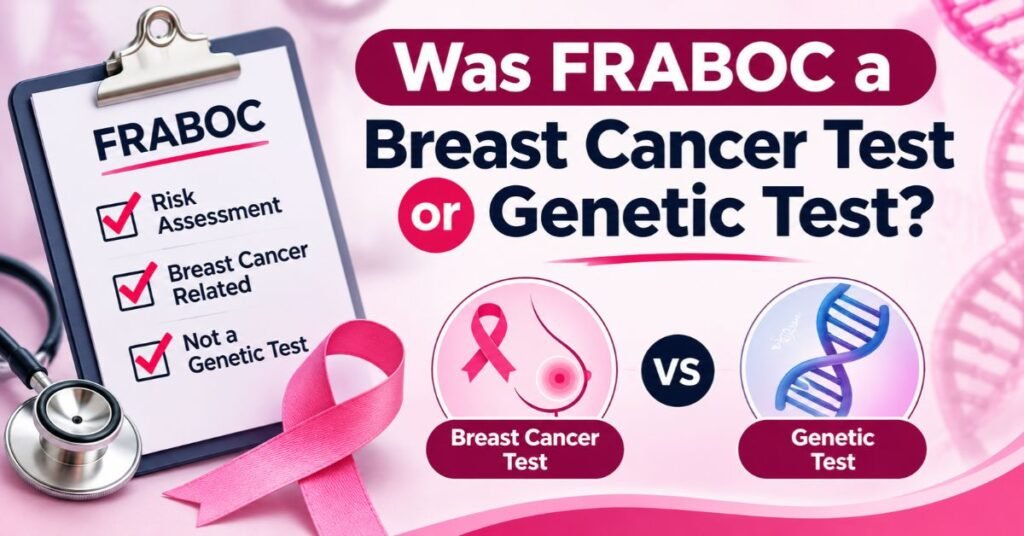
Let’s clear up a common mix-up. FRABOC was not a cancer test. It was not a genetic cancer risk assessment in the lab sense either. It was not a blood test, a mammogram, an ultrasound, or a scan. It could not find a tumour. It could not diagnose breast cancer or ovarian cancer. All it did was review a family history assessment and suggest a broad risk group. Nobody gave a sample. Nobody got a scan. The whole thing happened on a screen during a chat.
Why does this matter? Because people often read too much into risk labels. A tool like this works with groups of people. It cannot predict exactly what will happen to one person. Think of a weather forecast. A 70% chance of rain does not guarantee a wet day. Likewise, a woman with a strong family history may never develop cancer. A woman with no family history may still develop it. This is the heart of cancer risk prediction. It deals in odds, not fate.
FRABOC vs BRCA Genetic Testing: Key Differences
People often confuse the two. Yet they work in very different ways. FRABOC looked at family stories. BRCA genetic testing looks at DNA. Testing usually needs a blood or saliva sample. It checks for changes, also called inherited gene mutations, in the BRCA1 gene and the BRCA2 gene. These genes normally help repair damaged DNA. When they carry harmful changes, the risk of breast and ovarian cancer rises. FRABOC could never see these changes. It could only hint that a family pattern deserved a closer look.
So how did the two fit together? A high FRABOC result might lead a doctor to consider genetic counseling. A counsellor would then explain the pros and cons of testing. If testing went ahead, the result could confirm or rule out a gene change. For context, older Australian research on carriers of BRCA1 or BRCA2 changes estimated a cumulative lifetime breast cancer risk of roughly 50 to 60 percent. It put ovarian cancer risk at roughly 20 to 40 percent. These are estimates for confirmed carriers. They do not apply to someone who simply has a family history.
| Feature | FRABOC | BRCA Genetic Testing |
| What it examines | Family history | A person’s DNA |
| Sample needed | None | Usually blood or saliva |
| Detects gene changes | No | Yes |
| Main purpose | Estimate risk category and guide next steps | Identify changes in BRCA1, BRCA2, or other genes |
| Who uses it | Health professionals | Genetics services, with counselling |
What Happened After a Higher-Risk FRABOC Result?
A higher result did not set off alarms. It did not trigger automatic treatment. It did not order a test on its own. Instead, it gave the doctor a reason to pause and think. The result worked like a signpost. It pointed toward the next sensible step for that person. Each case was different. A woman in the moderate group might simply book a longer chat. A woman in the potentially high group might get a specialist referral within weeks. The clinical risk assessment was only the first move in a longer conversation.
Common next steps included a more detailed family history review, a referral to a family cancer clinic or genetics service, a talk about genetic counseling, and a discussion about screening and risk-reducing options. A high-risk breast clinic might offer a tailored plan. This could include personalized screening recommendations, lifestyle advice, and sometimes medicines or surgery for a small number of women.
Illustrative example (not a real patient): Meet “Sara”, a made-up 38-year-old. Her mother had breast cancer at 44. Her aunt had ovarian cancer at 52. Her GP used the older tool and placed her in the potentially high group. Sara was referred to a family cancer clinic. A genetic counsellor reviewed her tree. They talked about testing for the BRCA1 gene and BRCA2 gene. Sara chose to go ahead. The point of this story is simple. The label did not decide her future. It opened a door to expert help.
Is FRABOC Still Available in 2026?
Short answer: no. Cancer Australia has confirmed that the tool is no longer on its website. The agency now points health professionals to newer breast cancer risk tools. BreastScreen Queensland also notes that FRA-BOC has been replaced by iPrevent. So if you search for a working FRABOC calculator today, you won’t find an official one. Any site claiming to offer the old tool should be treated with care.
Why then do you still see the name? Old paperwork lingers. Many GP letters, PDFs, and referral forms were written years ago. They still carry the term in their text. Medical records also keep old notes for decades. If you see FRABOC on a document, it almost always refers to this retired tool. It does not mean the tool is active. It does not mean you must act on the old result. It simply tells you how a doctor once judged your familial cancer history.
What Replaced FRABOC? Modern Breast Cancer Risk Assessment Tools
Good news: better tools now exist. Cancer Australia directs people to iPrevent. Other modern risk assessment tools include CanRisk, which uses the BOADICEA model, and IBIS, also called the Tyrer-Cuzick model. These tools do far more than the old three-group system. They blend family history of breast cancer with personal data. Many of them produce a more tailored individual risk profile. That helps doctors plan personalized screening recommendations with more confidence.
Let’s meet each one. They share a goal. They aim to give a clearer estimate of breast cancer probability than a basic sorting tool could. Still, none of them can promise what will happen to you. They are breast cancer risk assessment tools, not crystal balls. A health professional should help you read the results. The sections below explain what each tool does and who may benefit from it.
iPrevent: A Modern Breast Cancer Risk Assessment Tool
Looking for the direct successor? iPrevent is it. This iPrevent risk assessment was developed by a team at the Peter MacCallum Cancer Centre. It is a validated breast cancer risk assessment and risk management decision support tool. Beyond family history, it can use personal health details, reproductive factors, lifestyle, and past breast disease. Family questions can cover breast, ovarian, pancreatic, and prostate cancer.
Queensland Health information says an assessment takes about 30 minutes. The result links to a risk category set by Cancer Australia. The tool is not meant for people who have already had invasive breast cancer or ductal carcinoma in situ (DCIS). It draws on established models, including IBIS and BOADICEA through CanRisk. Visit iPrevent to learn more.
CanRisk: Understanding Hereditary Cancer Risk
Have a complicated family tree? CanRisk may be a strong fit. The CanRisk calculator is an online tool built on the BOADICEA risk prediction model. It can give a detailed, personalized estimate using family history and other information. It shines when a family has many affected relatives. It also helps when genetic test results are available. Those results can sharpen the estimate of hereditary breast cancer risk. Clinicians usually run it for patients. This keeps the data entry accurate. You can read more at CanRisk.
IBIS (Tyrer-Cuzick): Estimating Breast Cancer Risk
What about the third option? The IBIS Tyrer-Cuzick model estimates breast cancer risk from family history and other personal factors. Examples include age, hormone history, weight, and prior breast conditions. The IBIS risk calculator gives a more detailed number than the three broad FRABOC groups. It is also one of the models running inside iPrevent. The Tyrer-Cuzick assessment is widely used around the world. Doctors in many countries rely on it to estimate lifetime cancer risk and guide screening plans.
See Also: TechTrendery Com USA What It Is, Features, Content, and Safety Guide 2026
Understanding Modern Breast Cancer Risk Categories
How are results labelled now? Queensland’s BreastScreen service describes current Cancer Australia categories by comparing a woman’s risk with the general population. This is a more personal way of talking about risk than the old groups. It also makes the label easier to link to a screening plan. Below you’ll see the three levels. Each level helps with breast cancer risk classification. Your doctor will explain what your category means for your own care.
| Category | Risk Compared With the Population |
| Average risk | Less than 1.5 times population risk |
| Moderate risk (somewhat increased) | 1.5 to 3 times population risk |
| High risk (substantially increased) | More than 3 times population risk |
FRABOC vs iPrevent: Key Differences Compared
Think of FRABOC as a paper map. Think of iPrevent as a live GPS. Both aim to help you find your way. The GPS simply knows more. FRABOC is no longer available. iPrevent is the current tool. FRABOC sorted women into three broad groups using family history. iPrevent combines family history with many other breast cancer risk factors to create a tailored estimate. FRABOC was meant for health professionals. iPrevent is designed for women and doctors to use together.
Why does this matter to you? A personalized estimate leads to better choices. Two women with the same family tree might have different risks once age, hormones, and breast history are added. The old three-bin approach could not capture that. This is a key reason FRABOC alternatives were developed. They offer finer detail and stay up to date with research. The table below sets the two side by side.
| Feature | FRABOC | iPrevent |
| Status | No longer available | Current tool |
| Main purpose | Family-based breast and ovarian cancer risk grouping | Breast cancer risk assessment and management |
| Method | Three broad risk groups | Personalized estimate using established models |
| Uses family history | Yes | Yes |
| Uses other personal factors | Limited | Yes |
| Primary users | Health professionals | Women and doctors together |
| Typical use today | Historical reference | Current assessment |
Why Does FRABOC Still Appear in Online Search Results?
Ever wonder why a retired tool still ranks on page one? The web has a long memory. FRABOC appeared in Australian health guidance for many years. That included advice for GPs and cancer fact sheets. Archived pages still exist. PDFs still float around. Referral templates still carry the term. Even medical records keep the name inside old notes. Every one of these items can show up in a search. So people keep typing the term and landing on old pages.
Then there is the travel mix-up. In flight listings, FRA is the code for Frankfurt Airport in Germany. BOC is the code for Bocas del Toro Isla Colón International Airport in Panama. Flight sites may show “FRA-BOC” or “FRA to BOC” for that route. It has no link to the cancer tool at all. If you land on a page about flights, you have simply met a naming coincidence. Search engines mix both meanings. Add words like “cancer” or “risk” to your search to avoid the confusion.
See Also: GrammarVista com USA The Ultimate Guide to Better Grammar in 2026
Should You Use Historical FRABOC Risk Figures Today?
Please don’t. The old percentages and group definitions help explain history. They do not tell you your own risk now. Science has moved on. Researchers have learned far more about inherited cancer risk and other breast cancer risk factors since the tool was built. Guidance on breast cancer screening has also been updated. Placing yourself in an old group could leave you falsely reassured. It could also cause needless worry. Neither outcome is helpful.
What should you do instead? Talk to a professional. A GP can review your family medical records and decide whether a modern tool fits. A family cancer service can offer expert genetic cancer risk assessment. Newer tools weigh more information and give more tailored results. That is the safer route. If an old FRABOC result appears in your records, share it with your doctor as background. Just don’t treat it as your current answer.
How to Prepare Your Family History for a Cancer Risk Assessment
Want a more accurate result? Do some homework first. A well-prepared family history assessment gives the doctor better data. Better data means a sharper risk estimate. You don’t need perfect records. Even rough notes help. Start by asking relatives what they remember. Write down names, relationships, and any cancer diagnoses. Do this for both sides of your family. Keep the notes in one place and bring them to your visit.
Gaps are normal. Many families lose track of details over the years. Don’t let that stop you. Share what you know and say which parts are uncertain. Doctors would rather hear “I think she was in her forties” than nothing at all. The simple table below can serve as a handy worksheet. Fill in one row for each relative with cancer. Bring copies of any genetic test results too.
| Relative and Side of Family | Cancer Type | Age at Diagnosis | Notes (Both Breasts? Genetic Test?) |
| Example: Mother (maternal) | Breast | 44 | Both breasts; no test yet |
| Example: Aunt (paternal) | Ovarian | 52 | Gene test result available |
Which Family Members Should You Include?
Include as many blood relatives as you can. Start with your first-degree relatives. That means your parents, brothers, sisters, and children. Then add your second-degree relatives. That covers grandparents, aunts, uncles, nieces, and nephews. Include both your mother’s side and your father’s side. Doctors call these the maternal family history and paternal family history. Relatives by marriage do not count because they do not share your genes. Adopted relatives and step-relatives may need special notes. Ask your doctor how to handle them.
What Cancer Details Should You Record?
Details make the difference. For each relative, note the type of cancer. Write down the age at diagnosis. Mark whether the cancer hit both breasts or happened more than once. Note any case of breast cancer in a man. Record whether any relative has had BRCA genetic testing and what it found. Bring copies of reports if you can.
Even small facts can shift your risk group. For example, a diagnosis at 38 carries more weight than one at 78. These clues help reveal inherited cancer patterns across the family.
Does Breast Cancer on Your Father’s Side Matter?
Yes, it does. Many people assume that only the mother’s side counts. That’s a myth. Gene changes linked to breast and ovarian cancer can pass through either parent. A father can carry a BRCA2 gene change and pass it to his daughters or sons. His sisters, mother, and aunts also matter. So never leave paternal family history off your list. Doing so could hide an important clue. When in doubt, include it and let the doctor decide how much weight it carries.
When Should You Speak to a Doctor About Your Family Cancer History?
Not sure when to act? Some signs are worth a chat. Speak with a doctor if several relatives had breast or ovarian cancer on the same side. Do the same if anyone was diagnosed young, if a relative had both breast and ovarian cancer, if a man in the family had breast cancer, or if someone has a known gene change. A new diagnosis in the family is also a good reason to check in. Early talks help with early detection and preventive healthcare.
Where should you begin? Your GP is the best starting point. They can review your family cancer history and use a modern tool if needed. If your risk looks higher, they can arrange a specialist referral to a family cancer clinic or genetics service. They can also explain breast cancer screening recommendations that match your needs. Remember, this article offers general information only. It is not medical advice. Speak with a qualified health professional about your own situation.
See Also: Deshoptec Com Explained What It Is, How It Works, and Is It Safe
Frequently Asked Questions
What Does FRABOC Stand For?
FRABOC, also written FRA-BOC, stands for Familial Risk Assessment – Breast and Ovarian Cancer. Cancer Australia published it as an online tool. It helped health professionals judge cancer risk from family history. It is now retired.
What Was FRABOC Used For?
Doctors used it to sort family cancer history into broad risk groups. It helped them decide on referrals to family cancer clinics. It also supported chats about screening and risk reduction. It was a guide only and never a diagnosis.
Is FRABOC Still Available?
No. Cancer Australia has confirmed that the tool is no longer on its website. The name still appears in older documents and referral forms. If you need a risk check today, ask your doctor about modern tools such as iPrevent.
Was FRABOC a Genetic Test?
No. FRABOC reviewed family history. It did not look at DNA. BRCA genetic testing and other genetic tests analyse a blood or saliva sample. That makes them very different from the old tool.
Could FRABOC Diagnose Breast or Ovarian Cancer?
No. It could not detect or diagnose any cancer. It only estimated family-related risk. Diagnosis needs medical tests such as imaging and biopsies. These must be arranged by a doctor.
What Replaced FRABOC?
Cancer Australia points to iPrevent. Other models in use include the CanRisk calculator, which uses BOADICEA, and the IBIS Tyrer-Cuzick model. These modern risk assessment tools give more personalized results than the old three-group system.
What Is the Difference Between FRABOC and iPrevent?
FRABOC sorted women into three broad groups using family history alone. iPrevent combines family history with other personal factors. It gives a more tailored estimate and a current risk category. FRABOC is retired while iPrevent is in use today.
Does Having Breast Cancer in the Family Mean You Are High Risk?
Not necessarily. Risk depends on how many relatives were affected and how closely related they are. The cancer types and ages at diagnosis also matter. One relative diagnosed late in life often means little change in risk. A doctor can help you make sense of it.
Can You Use iPrevent Without a Doctor?
Cancer Australia describes iPrevent as a tool that supports talks between women and their doctors. It works best when a health professional helps interpret the result. It is not intended for people who have already had invasive breast cancer or DCIS.
Does Breast Cancer on the Father’s Side Increase Risk?
Yes. Gene changes linked to breast and ovarian cancer can pass down through either parent. So both sides of your family belong in any family history assessment. Leaving out the father’s side could miss a key clue.
What Is the FRA-BOC Flight Route?
It is a travel code for Frankfurt (FRA) to Bocas del Toro, Panama (BOC). It has nothing to do with the cancer risk tool. The overlap in names is pure coincidence.
Should You See a Doctor About Your Family History of Cancer?
If you feel worried, yes. A GP is a good starting point. They can review your family medical history and use a modern tool if needed. They can also refer you to a family cancer clinic or genetics service.
Final Thoughts
Let’s wrap it up. FRABOC was Cancer Australia’s tool for turning family history of breast cancer into a broad risk group. It was simple and quick. It helped doctors decide who needed a closer look. It was never a cancer test. It was never a genetic test. It never gave a diagnosis. Most importantly, it is no longer available. If you meet the term on an old letter, think of it as a snapshot from the past.
So what should you do now? Look to the present. iPrevent, CanRisk, and the Tyrer-Cuzick model offer richer, more personal estimates. Start by gathering your family details. Then book a chat with your GP. Together you can pick the right tool and plan sensible breast cancer screening and breast cancer prevention steps. Knowing your family story is a powerful first move. You’ve already taken it by reading this far. Well done.


