
Results SFFareBoxing SportsFanfare Complete Guide to Boxing Results, Scores, and Records


You check the news after a big night of boxing fight results. You see one name and one word: “won.” That tells you almost nothing. How did the fight end? Was it close? What happened to the fighter’s record?
This guide fixes that. You will learn how to read results SFFareBoxing SportsFanfare style coverage from top to bottom. You will see how boxing scorecards work and how boxing records and statistics change after each bout. You will also learn where to confirm official boxing results. This is your SFFareBoxing SportsFanfare results guide in plain, easy English.
What Is Results SFFareBoxing SportsFanfare?
Fans type results SFFareBoxing SportsFanfare into a search bar for one simple reason. They want to know what happened in a boxing match. A good answer covers much more than a winner’s name. It shows the winning fighter, the defeated opponent, the method of victory, the round, the time, the scores, and the updated official fight record. Think of it as a full story instead of a headline. Those details turn SFFareBoxing results into something you can actually use.
Why does the method matter? Picture two fighters who both win. One wins by a first-round knockout. The other wins a tight unanimous decision (UD) after twelve rounds. Both earn a “W” on the record. Yet the fight outcome tells two very different stories. The first suggests power and speed. The second suggests patience and skill. That is why boxing match outcomes deserve a closer look than a quick glance at the winner.
How Fans Use SportsFanfare Boxing Coverage
Most readers use SportsFanfare boxing pages in three ways. Casual fans check boxing scores today to see who won last night. Dedicated fans study boxing results by fighter to follow a favorite boxer. Writers and analysts dig into boxing match history to spot patterns. Whatever your goal, the best habit is the same. Read the whole result line and not just the name at the top.
How to Read SFFareBoxing Fight Results
Learning how to read boxing fight results is easier than it looks. Most result lines follow one short pattern. Here is an example: “Fighter A defeated Fighter B – TKO, Round 7.” That single line gives you three facts. Fighter A won. The win came by technical knockout (TKO). The fight ended in the seventh round. Once you know this pattern, any result line starts to make sense.
Fights that reach the final bell look a little different. There is no stoppage round to report. Instead, you see a decision and the judges’ numbers. For example, you might read “Fighter A def. Fighter B – UD, 12 rounds, 116-112, 117-111, 115-113.” This tells you the fight went the full distance. It also shows that all three judges picked the same winner. Short lines like these pack in a lot of information, so slow down and read each part.
Common Boxing Result Abbreviations
Result lines use short codes to save space. You will see them on almost every site that posts professional boxing results. The table below explains the most common ones. Learn these nine codes and you can read nearly any result line with confidence.
| Code | Full Name | What It Means |
| KO | Knockout | A fighter is knocked down and can’t continue |
| TKO | Technical knockout | The referee, doctor, or corner stops the fight |
| UD | Unanimous decision | All three judges pick the same boxer |
| SD | Split decision | Two judges pick one boxer and one picks the other |
| MD | Majority decision | Two judges pick one boxer and one scores a draw |
| Draw | Draw | No fighter is declared the winner |
| DQ | Fight disqualification | A fighter loses for a serious rules violation |
| RTD | Retirement | A fighter or corner ends the bout between rounds |
| NC | No contest (NC) | The fight ends without an official winner |
Understanding Fight Outcomes and Result Formats
Every site writes results a little differently. Some put the winner first. Others list the fighters in the order they appeared on the poster. Some show the round as “R7” while others write “Round 7.” Even so, the core facts stay the same. Look for the winner, the method, the round, the time, and the scores. When you can’t find one of these, check a second source. This habit helps you with boxing fight updates and also with older boxing event results.
Different Types of Boxing Results Explained
A boxing result falls into one of two big families. The first family is the stoppage. A fight ends early because one fighter can’t continue. The second family is the decision. The fight goes the full distance and the boxing judges decide the winner. A few rare outcomes sit outside both families. These include draws, disqualifications, and no contests. Knowing the families helps you sort any boxing match result in seconds.
Why does this matter for a record? Because a win is not always the same kind of win. A knockout adds to a fighter’s knockout total. A decision does not. Fans and promoters pay attention to these numbers. A high knockout rate often makes a fighter more exciting to watch. A long list of close decisions can suggest a more careful style. This is why boxing decision results and boxing knockout results each get their own labels.
Knockout (KO) Results
A knockout (KO) happens when a fighter hits the canvas and can’t rise before the referee counts to ten. The count is the key. If the boxer beats it, the fight goes on. If the boxer can’t, the fight is over at once. No judges are needed. This is the cleanest kind of fight outcome because nobody can argue about the scorecards. A boxing knockout result usually lists the round and the exact time, such as “KO, Round 3, 2:15.”
Technical Knockout (TKO) Results
A technical knockout (TKO) is a referee stoppage without a full ten count. The referee may step in when a boxer takes too much punishment. A ringside doctor may stop the fight because of a cut or another injury. A corner may also throw in the towel to protect their fighter. In each case, the stopped fighter did not get knocked out cold. Yet the contest ends anyway. Some record keepers also count a retirement between rounds (RTD) as a TKO. Technical knockout results are common, and they often show how one fighter wore the other down over many rounds.
Unanimous Decision (UD)
A unanimous decision (UD) means all three judges pick the same winner. Their scores don’t have to match. For example, the cards might read 118-110, 117-111, and 116-112. All three favor the same boxer, so the result is a unanimous decision boxing win. This is the most common kind of decision. It often signals that the winner controlled the fight. Still, a UD can be tight on one card, so always read the scores.
Split Decision (SD)
A split decision (SD) means the judges disagree. Two judges pick one boxer and the third picks the other. The fighter with two votes wins. Split decisions often spark loud debate online. That makes sense, because one judge saw the fight in a very different way. When you see split decision boxing in a result line, check all three cards. The gap between the scores will tell you how close the fight really was.
Majority Decision (MD)
A majority decision (MD) is a mix of agreement and a draw. Two judges pick the same fighter. The third judge scores the bout even. The boxer with two votes wins. This is the key difference when people ask about difference between UD and SD. A UD has three matching winners. An SD has a direct disagreement. A majority decision boxing result sits between the two, because nobody actually picked the loser.
Draw and No Contest Results
A draw is an official result. Neither fighter wins. There are three types. A plain draw happens when the scores come out level. A majority draw happens when two judges score it even and one picks a winner. A split draw happens when one judge picks each fighter and the third scores it even. A no contest (NC) is different. It means the fight does not count as a normal win or loss. This can happen after an accidental clash of heads in the early rounds, or if a result is later overturned. This topic matters if you want help understanding boxing draws and no contests.
How Professional Boxing Scoring Works
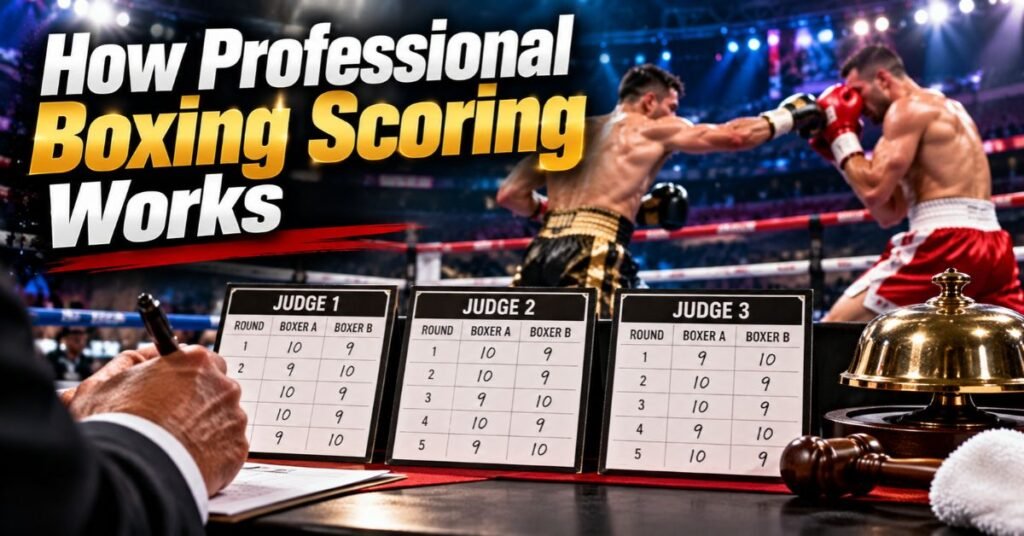
Three people, three scorecards, and a lot of pressure. That is the heart of how professional boxing scoring works. Each judge sits at a different spot around the ring. Each one scores every round on their own. Nobody talks to the others during the fight. At the end, the judges’ scorecards are added up round by round. The totals decide the winner. This is the boxing judging system in its simplest form.
Judges look at what they see in the ring and nothing else. Crowd noise, a fighter’s fame, and past records should not count. Of course, this is easier to say than to do. Rounds can be close, and some punches are hard to see from certain angles. That is why even skilled judges sometimes disagree. Learning how boxing judges score a fight helps you follow the logic behind each boxing round result.
The 10-Point Must System
Most pro bouts use the 10-point must system. The winner of a round gets 10 points. The loser gets 9 or fewer. So a normal round ends 10-9. If a fighter dominates and scores a knockdown, the round may end 10-8. A round that is truly even can end 10-10, although this is rare. Referees can also take away points for fouls such as low blows. At the end, the judge adds up all the rounds. For example, twelve rounds scored 10-9 for one fighter would give a card of 120-108 for a perfect sweep. A card like 116-112 means that boxer won eight rounds and the other won four.
Clean and Effective Punching
Effective punching usually carries the most weight. Judges want to see clean, hard shots that land on the target. A punch that hits the arms or gloves counts for little. A crisp jab to the chin counts for more. A power shot that rocks the opponent counts for most. Volume helps only when the punches actually land. A fighter who throws 100 shots and lands ten may lose to one who throws 40 and lands 20. Think of it like darts. Hitting the board is nice, yet hitting the bullseye wins.
Effective Aggression and Ring Generalship
Ring generalship means who controls the ring. The fighter who sets the pace and picks the spot usually has it. Effective aggression means moving forward and landing shots while doing it. Walking forward without landing anything does not count. A good example is a boxer who cuts off the ring and forces the other to back up while scoring clean hits. That fighter is leading the dance. Judges notice this, especially in rounds that are otherwise close.
Defense and Overall Performance
Defensive performance counts too. Slipping a punch, blocking a hook, or countering after a miss all help a fighter’s score. The great Muhammad Ali once described his style as “float like a butterfly, sting like a bee.” That line shows how defense and offense work together. A boxer who hits and doesn’t get hit looks smart and in control. Judges reward that skill, especially when the rounds are tight.
How Judges’ Scorecards Determine the Winner
At the end of the fight, the cards are collected and added up. Each judge gets one vote based on their own total. Three votes for the same boxer make a unanimous decision. Two against one make a split decision. Two for a boxer and one even make a majority decision. The table below shows how three sample cards work. This is a helpful way of how to interpret boxing scorecards at a glance.
| Judge | Fighter A | Fighter B | Vote |
| Judge 1 | 115 | 113 | Fighter A |
| Judge 2 | 114 | 114 | Draw |
| Judge 3 | 116 | 112 | Fighter A |
In this example, Fighter A wins by majority decision. Two judges favored Fighter A and one saw it even.
Fight Results vs. Fight Scores: Key Differences
People often mix up a result and a score. They are related but they are not the same. The result is the official fight outcome. It tells you who won and how. The score explains how the judges reached that call. Scores only exist when a fight goes to the cards. A knockout in round two has a result but no final score. This simple split clears up a lot of confusion about boxing fight results.
Why do scores matter? Because they show how close a fight was. Two fights can both end in “unanimous decision.” One might be 120-108 on all cards. The other might be 115-113 on one card. The first was a rout. The second was a battle. Fans who follow SFFareBoxing scores can use these numbers to judge how strong a win really was. The table below sums it up.
| Feature | Fight Result | Fight Score |
| What it tells you | Who won and how | How the judges saw each round |
| Always available? | Yes | Only if the bout goes to the cards |
| Example | Win by UD | 117-111, 116-112, 118-110 |
| Best use | Updating the record | Judging how close the fight was |
What Information Should a Complete Boxing Result Include?
A great result answers many questions at once. Who fought? Who won? How did it end? When did it end? Where did it happen? What was at stake? If a page leaves out half of these answers, you are left guessing. Think of a complete result as a small file. Every piece has a job. Together they form a clear picture of the boxing match.
Missing details cause real trouble. This is most true for older fights. A bare score line may not tell you the weight class or the event. Two boxers with the same name can also get mixed up. That is why a complete official boxing result is worth more than a quick headline. The table below shows a handy checklist you can use every time.
| Detail | Why It Matters |
| Fighter names | Avoids mix-ups between similar names |
| Winner and method | Shows how the fight ended |
| Round and time | Shows when the fight ended |
| Judges’ scores | Shows how close the fight was |
| Event and venue | Helps you find the card later |
| Weight class | Places the fight in the right division |
| Title status | Shows how big the fight was |
Fighter Names and Opponents
Start with the names. Both fighters should be listed in full. Many boxers share a last name, and some use nicknames. A clear name makes it easy to search boxing results by fighter name. It also helps when you want to learn how to check a boxer’s fight history. If the opponent is named as well, you can trace the same bout from either side. That is a smart trick when one fighter’s page is hard to find.
Winner and Method of Victory
The winning fighter comes next, along with the method. Was it a KO, a TKO, or a decision? Was there a fight disqualification? The method shapes how fans view the win. A knockout can raise a boxer’s name fast. A split decision can raise questions. This one line is often the most quoted part of any result, so check it with care.
Round, Time, and Fight Duration
For stoppages, the round and time are vital. A result such as “TKO, Round 8, 1:42” means the fight ended one minute and 42 seconds into the eighth round. Rounds and fight duration also show how long a fight lasted. A first-round finish and a tenth-round finish suggest very different stories. The first may show explosive power. The second may show pressure and slow damage. Every boxing round result adds to the full picture.
Judges’ Scorecards and Official Decisions
When a fight goes the distance, the judges’ scorecards are the proof. They show how each judge saw the bout. They also show whether the fight was one-sided or tight. A good result lists all three cards in full. If only the winner is shown, you lose a lot of context. This is true for any boxing decision results you read.
Event Details, Weight Division, and Championship Status
Last, look at the setting. The event name, the venue, the date, and the card position all help. So does the weight class, since fighters often move up or down during their careers. Boxing weight divisions such as lightweight, welterweight, and heavyweight set the stage for each fight. Finally, check if it was a championship bout or a title fight. A championship fight result carries more weight than a regular bout. It can change boxing rankings and a fighter’s whole career path.
How Boxing Results Affect Fighter Records and Rankings

Every official fight changes a boxer’s numbers. A win-loss-draw record is written as wins, then losses, then draws. A boxer listed as 24-2-1 has 24 wins, 2 losses, and 1 draw. After the next fight, one of those numbers goes up. This is the simplest answer to how fight results affect boxer records. The official fight record is the base for all fighter win-loss records and boxing records and statistics.
Records also drive the bigger picture. Promoters, fans, and boxing commission officials watch them closely. A strong record can open doors to bigger fights. A loss can slow a rise, although it rarely ends a career. Rankings follow as well. Each sanctioning body has its own rules, so no two lists match exactly. Still, the pattern is simple. Wins over good opponents usually help. Losses to good opponents may not hurt much.
Read More: Afextop Com Review 2026 Features, Content, Safety, and Legitimacy
Changes to Wins, Losses, and Draws
The math is easy. Say a boxer is 24-2-1. A win makes it 25-2-1. A loss makes it 24-3-1. A draw makes it 24-2-2. A no contest usually does not change the numbers, though some record keepers list it separately. Knockout totals may be shown next to the main record. A record like 25-2-1 (20 KOs) tells you that 20 of the 25 wins came by knockout. That is a handy sign of a hard hitter.
Impact on Fighter Rankings and Career Progress
Boxing rankings shift after big fights. A win over a top-rated rival can lift a boxer several spots. A loss may push a fighter down. How boxing rankings change after a fight depends on the sanctioning body and on the opponent’s rank. How championship fight results affect rankings is even more direct. A new champion takes the top spot in the division. The old champion may drop or get a rematch. Keep this in mind when you track a rise to the top.
Why a Fighter’s Performance Matters Beyond the Result
A record only tells part of the tale. Take a short case study. Imagine two boxers who are both 20-1. The first beat former champions and top contenders. The second beat mostly new fighters. Their records match, yet their skill levels do not. That is why boxing performance analysis looks at more than wins. Opponent quality, recent form, knockout rate, and the quality of losses all matter. This is the heart of analyzing fighter performance beyond wins and losses.
Main Event, Co-Main Event, and Undercard Results
A boxing night is a card of many fights. The card has a clear order. At the top sits the biggest fight. Below it sit the other big ones. At the bottom are the early bouts. Fans who read only the top line miss most of the show. Reading the whole card gives you far better boxing event results.
The full card is also a great place to find rising stars. Many future champions started on the early part of the bill. A strong win on the undercard bout can lead to a spot on a bigger event. So when you scan SFFareBoxing results for a night of boxing, look past the top fight. You may spot the next big name.
Understanding Main Event Results
The main event is the star fight of the night. It usually features top contenders or champions. Fans pay the most attention to it. The result often becomes the headline, and it can also change boxing rankings. A title fight in the main event can crown a new champion. That makes the main event result the most searched part of any card.
Co-Main Event Outcomes
The co-main event is the second-biggest fight. It sits right below the headline bout. Often it features a strong contender or a rising prospect. Sometimes it is nearly as big as the main fight. Co-main outcomes can set up the next big matchup. A strong win here may lead to a main event spot next time.
Undercard Fight Results
The undercard bout results cover the rest of the night. These fights often feature prospects, regional champions, and young talent. Many fans skip them. That is a mistake. Strong boxing results by event date can show who is climbing. Watching these fights early lets you follow a boxer from the start.
How to Find Specific SFFareBoxing Fight Results Faster
Searching a whole history of fights wastes time. A faster method is to start with what you already know. Maybe you know a name. Maybe you know a rough date. Maybe you know the opponent. Each clue helps. Combine two clues and you can find a result in seconds. This is the easiest way to learn where to find official boxing results without a long hunt.
Good search habits also help you avoid errors. Always use full names when you can. Add the year or month. Then confirm the result with a second source. These steps take a minute. They can save you from reading a wrong or outdated page. Use them for latest boxing fight results and for old boxing match history alike.
Search by Fighter Name or Opponent
Type the boxer’s full name. If their page is hard to find, search the opponent instead. The same fight will appear on both pages. This trick works well for lesser-known boxers. It also helps when two fighters share a name. Searching boxing results by fighter name is the quickest way to see an entire career at once.
Check the Fight Date and Event
Even a rough date can narrow the search a lot. A month and a year may be enough. Once you find the event, you can see every bout on the card. This is a smart way to use boxing results by event date. It also helps when you want the boxing match schedule and the finished results side by side.
Verify the Result and Updated Fighter Record
Before you trust a result, check the record. Compare the boxer’s record before the fight and after it. If the numbers changed by one win, the result was likely a win. If they did not, something is wrong. This step is the key to how to verify a boxing match outcome. It adds official result confirmation to your search in a simple way.
Read More: BD268XZ Explained Meaning, Uses, Benefits, and Future in Digital Systems
Why Boxing Results May Change After a Fight
Most results stay as they are. A few do not. Early reports after the final bell can be wrong. A scorecard may be misread. A name may be mixed up. Social media posts move fast and sometimes miss details. That is why the final record matters more than a first tweet. When you ask why boxing results may be overturned, the answer is usually a review, an error, or a rule issue.
Official records beat quick posts every time. A boxing commission or a sanctioning body keeps the real record. When a change happens, they update it. Sites then follow. If you see two different results online, trust the one that matches the official source. This simple rule keeps your facts clean.
Official Reviews and Corrected Records
Sometimes a result needs a fix. A judge may add up a card wrong. A site may post the wrong score. In these cases, the official record is corrected. The change is usually small. Even so, it shows why official boxing results from a trusted source matter. If you see a surprising score, check the commission’s record first.
Disqualifications, Appeals, and No Contest Decisions
A boxing appeal can lead to a change. So can a failed drug test. A result may be switched to a no contest (NC). A fight disqualification may also be reviewed. This answers a common question about what happens after a boxing disqualification. The fight result may stand, or it may be changed after a hearing. Each case is different. Always check the final ruling and not the first report.
How Recent Boxing Results Connect With Fight Schedules
Every fight follows the same cycle. First, a fight is scheduled. Then it happens. Next, the official result is posted. Last, the fighter’s record updates. This chain links boxing event schedules and completed fights into one story. A listing in the boxing match schedule eventually becomes part of history. Following the whole chain helps you see where a boxer has been and where they may go.
Recent results also help you size up upcoming fights. A boxer’s last three to five bouts show current form. They reveal momentum, opponent level, and any weight changes. A fighter with a long record may be in a slump. A fighter with early losses may be on a hot streak. This is a key part of tracking professional boxing performance.
Checking Upcoming Boxing Events and Participants
Before the fight, look at the card. Check the date, the venue, and the weight class. Note who is fighting on the main event and co-main event. Look at each fighter’s recent bouts. This prep makes the night more fun. It also gives you a base to compare against when the results arrive.
Following Results After Live Fights
After the final bell, check for the latest fight outcomes and records. Start with the main event. Then scan the rest of the card. Wait for the full official result confirmation before you share a result as final. Good boxing fight updates come once the scores and records are posted. This small habit protects you from spreading mistakes.
How to Interpret Close and Controversial Boxing Results
Everyone watched the same fight. Yet nobody scored it the same way. This happens in boxing all the time. A round can go either way. A judge may favor busy work. Another may favor power. Fans may side with the fighter they like. That is how controversial boxing decisions begin. The key point is simple. A controversial result is not always a wrong result.
So how should you judge a close fight? Start with all three judges’ scorecards. Count the close rounds. Look for knockdowns and clean hits. Think about ring generalship and defensive performance. A short case study helps. Imagine a fight scored 115-113, 114-114, and 116-112. Fans might argue for days. Yet the cards show that many rounds were near coin flips. This is the practical side of understanding controversial boxing decisions. The official result stays in the record unless the proper authority changes it.
Common Mistakes to Avoid When Reading Boxing Results
New fans often trip on the same few things. Terms like KO and TKO sound alike. Scores can look like random numbers. Draws and no contests seem the same. None of these is hard to learn. A little care goes a long way. Avoiding these errors will make your boxing fight results reading much sharper.
Each mistake below is easy to fix. You only need to know what to look for. Keep this short list in mind the next time you check a boxing match. You will read results faster and with more trust.
Confusing Knockouts With Technical Knockouts
Both end the fight early. Yet they are not the same. A knockout (KO) means the fighter could not beat the count. A technical knockout (TKO) means someone else stopped the fight. This covers the referee, a doctor, or a corner. It is the heart of the difference between KO and TKO. Mixing them up can hide the real story of how the bout ended.
Read More: TheJavaSea me Leaks AIO TLP371 Risks, Facts, and Online Safety Guide 2026
Ignoring Judges’ Scorecards
Many fans read the winner and move on. That skips the best clue. The judges’ scorecards show how close the fight was. A 120-108 card tells a very different tale than a 115-113 card. Skipping the numbers means missing the full fight outcome. Always glance at the cards for any fight that went the distance.
Confusing a Draw With a No Contest
A draw is an official result. The fight finished and the scores came out even. A no contest (NC) is not a normal win, loss, or draw. The bout simply does not count in the usual way. A boxer’s record may change after a draw. It usually does not change after a no contest. Know the gap and you won’t misread a record.
Overlooking Fight Dates and Official Updates
Boxers fight many times. An old result can look like the latest one. Always check the date. Also check for updates. A result may have changed after a review. This is a small step. Yet it keeps you from quoting outdated facts. It also keeps your boxing records and statistics accurate.
How to Use SFFareBoxing SportsFanfare for Boxing Research
Boxing research can be as simple or as deep as you like. A casual fan may only want to know who won. A keen follower may study career arcs. A writer may build a story from years of boxing match history. All of them can use the same tools. They just go to different depths. The key is to look beyond the final result and see the context around it.
Context turns raw facts into insight. A win means more when you know the opponent. A loss means less when it came against a champion. A knockout means more when it came late in a hard fight. That is the power of the SFFareBoxing SportsFanfare results guide approach. It asks you to read all the details and not only the headline.
Comparing Results Across Multiple Fights
Put several fights side by side. Look at methods, rounds, and opponents. Do you see a pattern? Maybe a boxer wins mostly by decision. Maybe another stops opponents early. Comparing boxing fight statistics across bouts lets you spot style and strength. This works well for boxing performance analysis.
Tracking Fighter Performance Over Time
A single fight is a snapshot. A series of fights is a movie. Track a boxer’s last five to ten bouts. Watch how the weight class, the opponents, and the methods change. Look for growth or decline. This is the best way of tracking professional boxing performance, and it helps you predict what may come next.
Verifying Results With Official Boxing Sources
Always double-check key facts. Good places include state and national boxing commission sites and sanctioning body pages. The Association of Boxing Commissions lists member commissions in the United States. The database BoxRec is also widely used for fight histories and records. Check each site for the exact fight and compare it with your first source. This is the best way to do official result confirmation.
Frequently Asked Questions
What Are Results SFFareBoxing SportsFanfare?
The phrase results SFFareBoxing SportsFanfare refers to boxing coverage that reports winners, methods, scores, records, and event details. It helps fans understand how a fight ended and what it means for each professional boxer. Treat any site as one source among several, and always confirm key facts with an official record.
What Information Appears in Boxing Results?
A full result shows the fighter names, the winner, and the method of victory. It also lists the round, the time, the judges’ scorecards, the weight class, and the event. For a championship bout, it also shows the title status. Together, these details give you the complete fight outcome.
What Does KO Mean in Boxing?
KO stands for knockout. It happens when a boxer is knocked down and can’t get up before the referee counts to ten. The fight ends right away. No judges are needed. A KO is one of the clearest boxing knockout results in the sport.
What Does TKO Mean in Boxing?
TKO means technical knockout. It happens when the referee, a ringside doctor, or a corner stops the fight. The boxer may still be standing. Yet it is not safe to go on. This is a referee stoppage in most cases.
What Does UD Mean in Boxing Results?
UD means unanimous decision. The fight went the full distance. All three boxing judges picked the same winner. Their scores may differ slightly. Yet each one chose the same boxer, so the result is a clear win.
What Is the Difference Between a Split Decision and a Majority Decision?
In a split decision, two judges pick one boxer and the third picks the other. In a majority decision, two judges pick one boxer and the third scores the fight as a draw. So an SD has a real disagreement. An MD has two votes for a winner and one even card.
Is a No Contest the Same as a Draw?
No. A draw is an official result with level scores. A no contest (NC) means the bout does not count as a normal win, loss, or draw. A draw may change a record. A no contest usually does not.
Where Can I Verify Official Boxing Results?
Start with the boxing commission that oversaw the event. You can also check the sanctioning body that ran the title fight. Records databases such as BoxRec help you compare histories. Use at least two sources before you call a result final.
Conclusion
Results SFFareBoxing SportsFanfare coverage works best when you read it as a full story. The winner is only the start. The method, the round, the time, the judges’ scorecards, and the updated official fight record all matter. Terms like KO, TKO, UD, SD, MD, draw, and NC also become easy once you know them. With a little practice, you can read any boxing fight result in seconds.
Remember to look beyond the result. Study the opponent, the form, and the event. Check dates and confirm the facts with trusted sources. Do this and you will follow boxing rankings, fighter win-loss records, and boxing event results like a pro. The next time you see a fight result, read the whole line. You might be surprised by how much it tells you.


